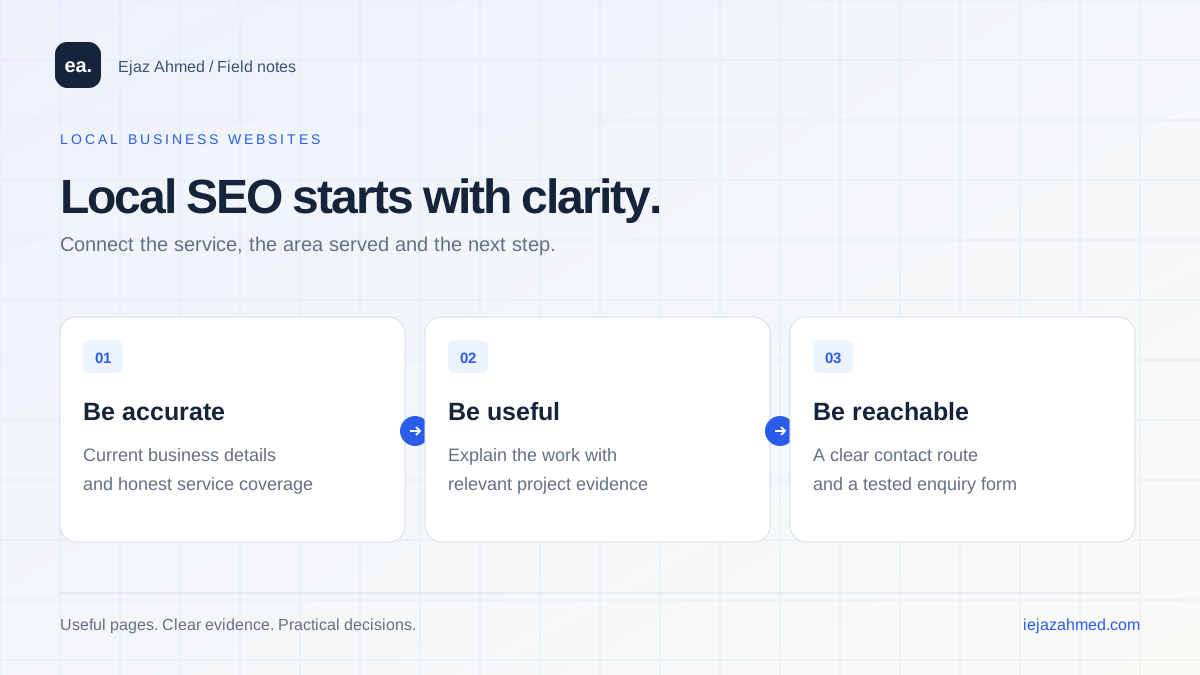
Local SEO helps people understand what a business does, where it operates and how to contact it. For a small service business, the useful starting point is accurate information and a clear customer journey. AI-generated search answers add another way information may be presented, but they do not remove those basic requirements.
Make the business easy to understand
A visitor should quickly find the services, the area actually served and a working contact method. Avoid replacing a useful explanation with a list of towns or repeated “best service near me” phrases. If work is remote, describe that honestly rather than suggesting offices that do not exist.
For example, a developer can explain whether a project covers a customer portal, school administration or retail billing. Those descriptions help a prospective client decide whether the service fits before sending an enquiry.
Keep business information consistent
Use a consistent business name and current contact details across the website and profiles you control. Check mobile contact links, opening hours where relevant and any address shown to customers. A broken enquiry form can lose a lead even when a search listing attracts the right person.
If the business qualifies for a Google Business Profile, maintain its accurate details and follow the applicable eligibility rules. Google describes local ranking through relevance, distance and prominence; adding a city to a heading does not override those factors.
Give each important service a useful explanation
A service page should answer a customer’s decision questions: what problem is handled, what the work includes, what information is needed and what happens after contact. Add relevant project evidence instead of duplicating the same paragraph across many location pages.
- Explain the actual scope: a restaurant ordering flow is different from a simple brochure website.
- Show a real screenshot or link to a documented project where appropriate.
- Describe constraints, such as the information needed before estimating a custom system.
- Offer one clear next step, with a working form or email link.
Use reviews and structured data honestly
Genuine reviews help potential customers understand previous experiences. Ask for an honest account of the work rather than supplying praise or asking people to insert a target keyword. Respond constructively when a review raises a problem.
If structured data is used, it should match the business information visible on the page. It is a way to describe content, not a way to invent an address, a rating or customer feedback. No markup can promise a local recommendation or a place in an AI answer.
Measure enquiries alongside visibility
In Search Console, look at the pages and queries that receive impressions. Separate branded searches from service searches, and check the relevant country and device. In your own enquiry records, note which service was requested and whether the enquiry matched the work you offer.
A page with impressions but a low average position needs a different investigation from one that ranks visibly and receives few clicks. A page that gets visits but no qualified enquiries may need a clearer offer or a simpler contact flow. Small numbers should be interpreted over a meaningful period, not a single day.
A practical first improvement
Choose one important service, improve its explanation and check every step from its search snippet to the enquiry confirmation. Record what changed so a later comparison has a useful reference point.
For examples of specific business problems, explore DinePulse and Shop Invoices. Read the SEO checklist for the crawlability and canonical checks behind a website.
Common questions
Should I create a page for every nearby town?
Only where there is a useful, accurate service explanation for that audience. Repeated pages with different place names do little to help a customer make a decision.
Does a local business need a long blog?
Useful service information, real evidence and reliable contact details can be more urgent. Add articles when they answer questions your customers actually have.